
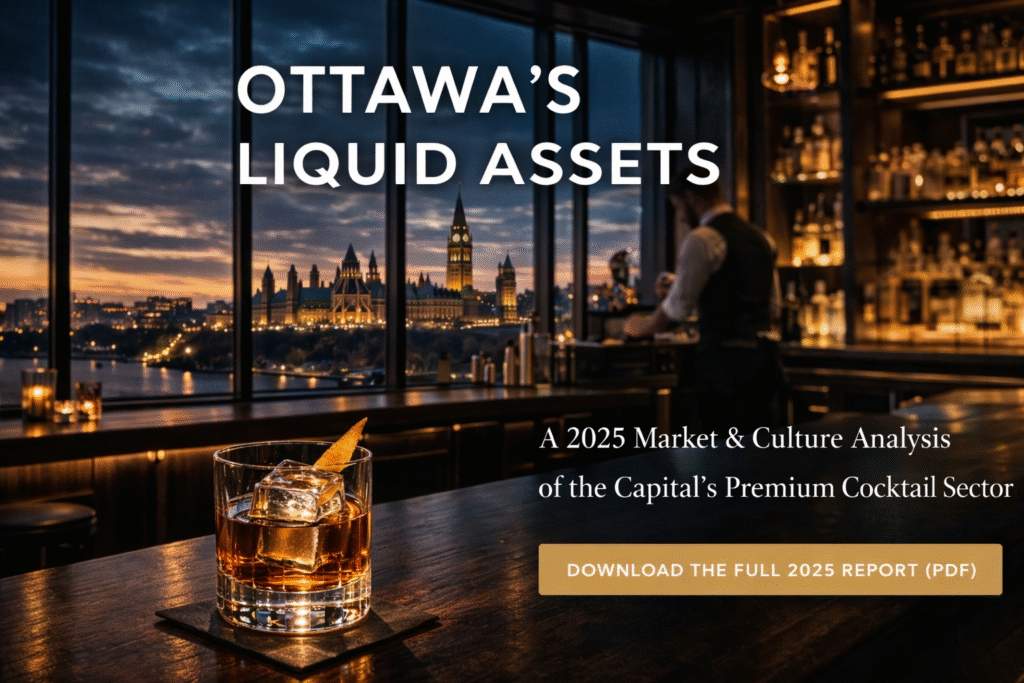
2025 Ottawa Cocktail Market Report
A Hybrid Market & Culture Analysis of Pricing, Pricing Tiers, Spatial Design, and Operational Sophistication
An Independent Annual Study
Published on: March 1st 2026
Author: Daniel Lachance
Methodology
Summary
Ottawa’s cocktail market in 2025 was structurally mature, competitively dense, and culturally self-aware.
The city now supports approximately 21 qualifying cocktail-forward venues across four distinct pricing tiers. The dominant market equilibrium sat between $17–$20 per cocktail, with clear premium extensions above $21 sustained by venues that justify pricing through spatial investment, prep intensity, and brand identity.
The defining shift of 2025 was bar centrality.
“Ottawa’s premium cocktail sector has entered structural maturity”
Across the competitive set, venues consistently allocate 25–40% of primary room footprint to the bar, employ L-shaped bar designs, and prioritize visible drink-building as part of the guest experience. Ice quality, in-house production, and seasonal rotation have become standard indicators of seriousness.
Ottawa is no longer an emerging cocktail city. It is a stabilized, internally stratified market competing horizontally within its core pricing band.
1. Market Definition & Competitive Set
Inclusion Criteria
- Cocktail-focused venues
- Restaurants with serious bar programs
- Lounges and hotel bars
- Speakeasies
- Hybrid beverage-forward venues
Geographic Boundary
Ottawa qualifies.
No Gatineau venues currently meet inclusion thresholds for cocktail intensity.
Qualifying Venues (21)
- 10Fourteen
- Apothecary
- Bar Lupulus
- Bar Ocelli
- Datsun
- Drip House Cocktail Bar
- Ember
- Fauna
- Gitanes
- Jackalope
- Le Poisson Bleu
- Lexington
- Little Sussex
- Mati
- Riviera
- Stolen Goods
- The Belmont
- The Hyde
- The Moonroom
- Tredici
- Zoe’s Lounge
2. Pricing Architecture
Tier I — Accessible Craft ($14–$16)
Lower-band venues and hybrid models emphasizing approachability.
Bar Lupulus operates at $14–$18, underpricing relative to operational sophistication.
Tier II — Core Market ($17–$19)
The city’s equilibrium zone.
Includes Belmont ($18 flat), Lexington ($17–$19), Datsun ($16.50–$20), and most restaurant-hybrid programs.
This is the competitive compression band. Differentiation must come from quality and identity, not price.
Tier III — Upper Premium ($20–$23)
Tier IV — Luxury Ceiling ($24+)
Zoe’s Lounge – Sustained by hotel luxury positioning and top-tier boutique craft bars.
Key Finding:
Ottawa supports premium pricing — but only when operational and spatial signals align with price.
3. Spatial Design: The Bar as Revenue Engine
Common Structural Traits:
- L-shaped bar geometry (dominant form)
- 7–12 bar seats are typical
- 25–40% room footprint allocated to bar
- Visible speed rails and ice wells
- Guest-facing drink construction
Ottawa venues are no longer treating bars as secondary to dining rooms. The bar is a revenue center and experiential stage.
Cultural Implication:
4. Operational Sophistication
Operational intensity varies meaningfully across the competitive set.
Ice Programs
Clear ice (premium signalling):
- Bar Lupulus & Stolen Goods (logo-stamped)
- Little Sussex (hand-carved)
- Multiple upper-tier venues
Large ice cubes:
- Belmont
- Datsun
- Lexington
- Many restaurant hybrids
Ice quality now functions as a tier signal.
In-House Production
High-intensity programs (infusions, cordials, fat washes, acid adjustments):
- Bar Ocelli
- Stolen Good
- Jackalope
- Riviera
- Little Sussex
- Bar Lupulus (notable overperformance at its price band)
Moderate intensity:
- Lexington
- Belmont
- Apothecary
- Gitanes
- Minimal prep:
- Datsun
- Some transitional restaurants
Prep intensity correlates strongly with pricing power above $20.
Rotation Cadence
Seasonal rotation of the cocktail menu items is now standard.
Static cocktail lists are increasingly rare among serious venues.
This is an indication of market maturity.
5. Backbar Capital Allocation
Backbar depth of spirits and liqueurs (excluding bar rail and fridge) ranges from:
~50 SKUs (eg. Belmont)
~60 SKUs (eg. Datsun)
~80 SKUs (eg. Fauna)
100+ SKUs (eg. Riviera)
Median serious venue range: 60–90 bottles.
The market favours curated depth over encyclopedic excess.
Backbar investment aligns with pricing tier and brand ambition.
6. Revenue Model Typologies
Ottawa supports three dominant models:
1. Restaurant-Stabilized Cocktail Programs
E.g. Belmont, Lexington, Fauna, Datsun
Food revenue reduces cocktail margin pressure.
The bar footprint is still significant, but not the exclusive focus.
2. Boutique Craft Cocktail Bars
I.e. Stolen Goods, Bar Ocelli, Jackalope
High prep, high margin, limited seating, premium pricing.
3. Hybrid Beverage Programs
Bar Lupulus (beer + wine + craft cocktails): Cross-category sophistication; lower pricing but strong operational signals.
Riviera and Mati function as high-volume restaurant hybrids with premium-bar signalling.
7. Cocktail Culture Maturity
Ottawa’s cultural signals in 2025:
- Signature-heavy menus dominate (7–10 cocktails standard)
- Seasonal adaptation normalized
- Clear ice adoption spreading
- L-shaped experiential bars ubiquitous
- Prep transparency expected
- $18 average pricing is increasingly common
The market has diversified beyond its original “OG” cocktail bars (i.e. Trio, The Moonroom). No single venue defines the city.
The competition is now horizontal.
8. Competitive Pressure & Market Stability
New openings and venue rebrandings throughout 2025 signal:
- Stable demand for premium cocktails
- Increasing density in the $17–$20 band
- Competitive differentiation shifting toward craft nuance and spatial identity
Closures appear strategic rather than systemic. Ottawa’s market is competitive but not yet saturated.
9. Structural Strengths of the Ottawa Market
- Clear pricing tiers
- High spatial investment
- Seasonal agility
- Emerging prep sophistication
- Strong mid-market density
- Clear luxury ceiling
10. Structural Risks
- Pricing compression in the $17–$20 band
- Over-reliance on cloudy ice in mid-tier venues
- Limited late-night positioning across many venues
- Similar L-shaped bar geometry reduces architectural differentiation
11. 2026 Outlook
Expect:
- Wider adoption of clear ice
- Increased prep intensity in mid-tier venues
- Greater emphasis on branded or proprietary spirits
- More cross-category beverage programs
- Increased differentiation via narrative and identity rather than price
The next phase of competition will be experiential and technical.
Final Assessment
Ottawa in 2025 is a mature cocktail city, because it supports:
- Premium pricing
- Sophisticated prep
- Bar-forward architecture
- Hybrid beverage models
- Competitive density across tiers
The defining characteristic of this market is not extravagance, but rather intentionality. Venues that align pricing, space, and operational rigour will sustain pricing power. Venues that rely solely on equilibrium pricing without differentiation will feel margin pressure. The market is stable, competitive, and increasingly self-aware.